If a single herb has come to define the modern adaptogen moment, it is ashwagandha. The name surfaces in podcasts, on café menus, and across supplement shelves, often trailing bold promises. Behind the hype sits a genuinely venerable plant, one that Ayurvedic practitioners have relied on for thousands of years. It deserves neither breathless praise nor reflexive dismissal, but a clear and curious look.
An ancient root in a modern jar
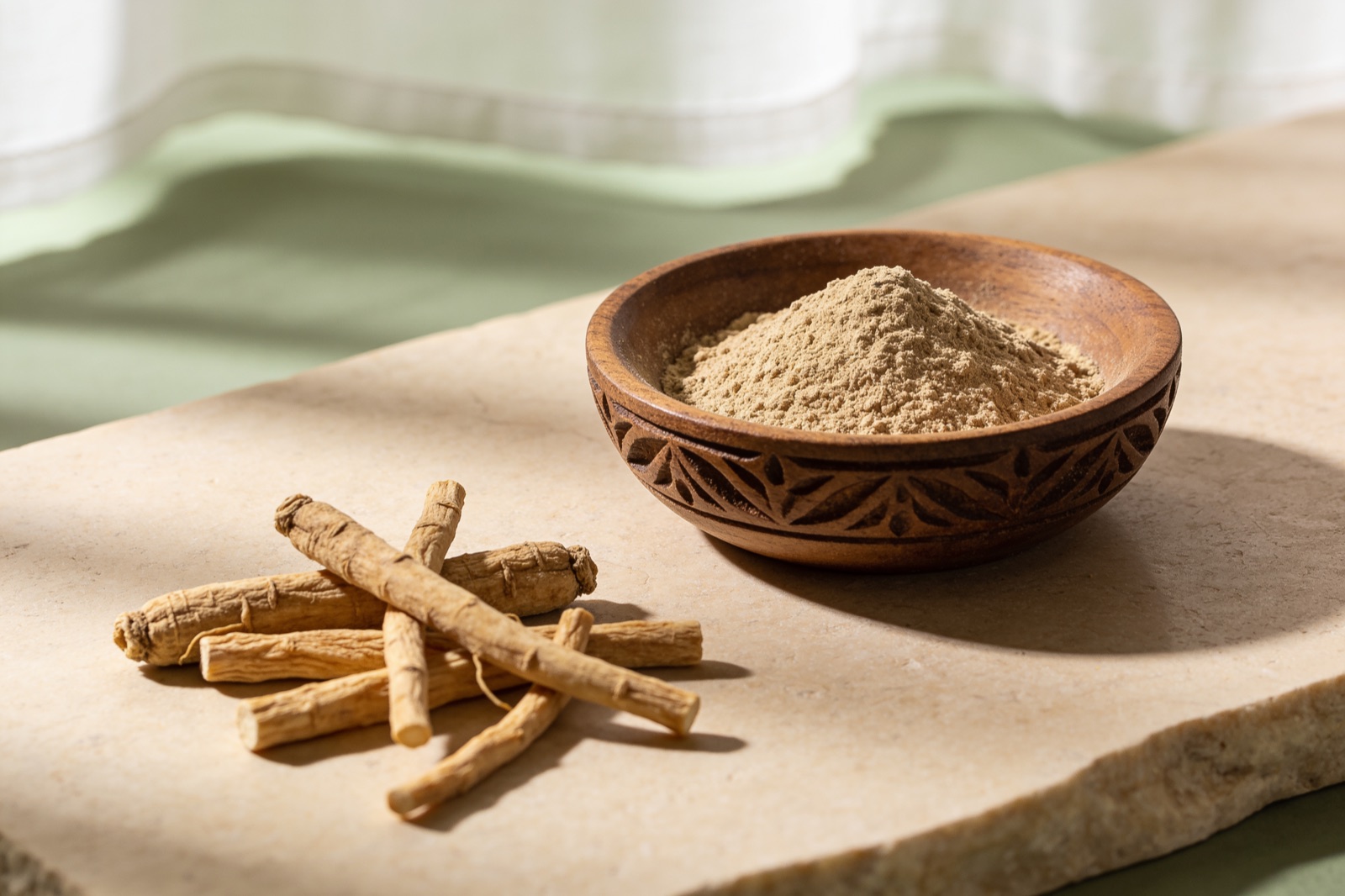
Ashwagandha is a small shrub whose root has long been central to Ayurveda, the traditional medicine of the Indian subcontinent. Its Sanskrit name is often translated as the smell of a horse, a nod both to its earthy aroma and to the strength it was thought to confer. Classical texts describe it as a rasayana, a rejuvenating tonic meant to be taken over time to restore vitality and calm.
That framing is useful today. Ashwagandha is best understood as a slow, restorative herb rather than a fast-acting fix, something you build into your weeks rather than reach for in a crisis.
What the evidence suggests
Ashwagandha is among the more studied adaptogens, and the research, while still maturing, is encouraging. Consensus leans toward a genuine role in easing perceived stress and supporting a sense of calm, with a number of trials pointing to improvements in sleep quality as well. Some studies have explored effects on exercise recovery and stamina, though this evidence is more preliminary.
A few honest caveats keep expectations grounded. Many trials are small or short, and they use standardized extracts at specific doses, so results do not automatically transfer to every powder on the shelf. The effect, when it comes, tends to be subtle and cumulative rather than dramatic. Think of it as taking the edge off, not transforming the day.
Ashwagandha does not make you calm so much as it makes you a little less reactive, and over weeks that difference quietly adds up.
Choosing a form that suits you
Ashwagandha comes in several guises, and the right one depends on your habits.
- Capsules of standardized root extract are the most convenient and the closest to what most studies use, which makes dosing predictable.
- Powder, the traditional form, can be stirred into warm milk in the classic Ayurvedic style, though its bitter, earthy taste is not for everyone.
- Tinctures offer flexible dosing in liquid form and absorb readily.
Whatever the form, look for products that specify the plant part as root, name a standardized extract, and carry third-party testing for purity. Modest, consistent daily use tends to serve people better than large sporadic doses.
Fitting it into real life
Because ashwagandha is calming rather than stimulating, many people take it in the evening, where it may support both a settled mood and better sleep. Others prefer a morning dose to steady the whole day; there is no single correct time, so let your own response guide you. Give any new routine a few weeks of consistency before deciding whether it earns a place, and notice the ordinary signals: an easier bedtime, a longer fuse, a calmer middle of the afternoon.
As with any adaptogen, it works best as one supporting player among the fundamentals. No root outperforms a decent night's sleep, and the herb shines brightest when the rest of your life is pulling in the same direction.
Approached with patience and a little discernment, ashwagandha lives up to its old reputation as a root of calm energy, not a shortcut, but a steady companion for a nervous system that could use one.